How to review practice exam mistakes
Use a short error log to understand wrong answers, choose a follow-up task and check what changed.
Contents
To review practice exam mistakes, keep your original attempt, find the first point where your reasoning went wrong and choose a specific follow-up task. A score tells you how that attempt went. A useful review tells you what to do before the next one. You do not need an elaborate spreadsheet to make that distinction.
This guide provides an original error-log template and a worked example. Use it with practice materials you are allowed to keep. For a returned assessed paper, follow your course rules on copying, annotation and access. Keep questions, marking guidance and your own notes clearly separated.
Keep the attempt before correcting it
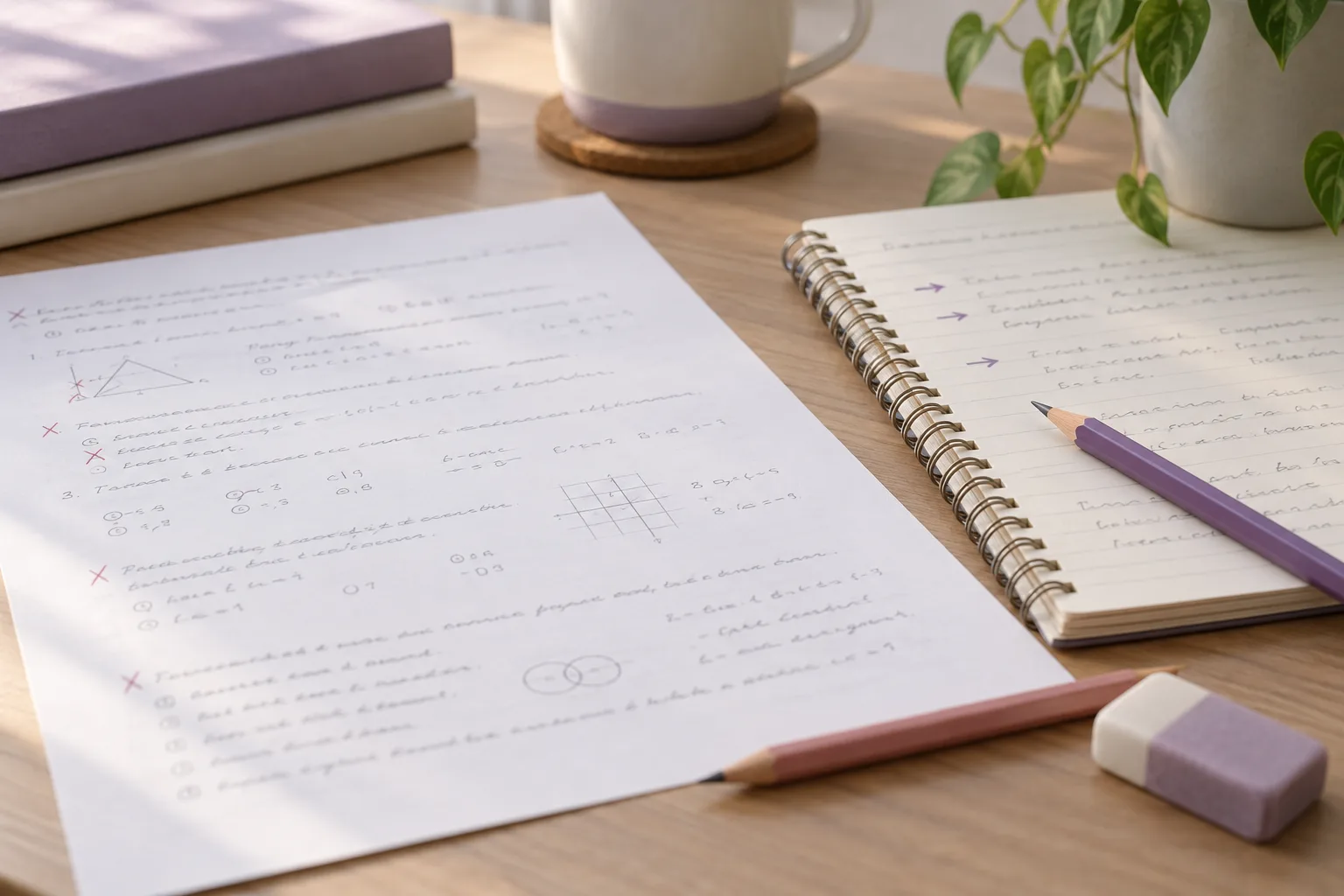
Do not immediately erase a wrong calculation or replace an answer with the model response. Your first attempt contains evidence: the information you selected, the method you tried and the place where you ran out of time. Put corrections beside it or on another page so that you can compare the two.
Write down the conditions as well. Was the exercise timed? Were notes open? Had you seen the questions before? Cornell’s practice-exam guidance recommends matching the real test’s conditions and permitted resources. A result from an open-notes attempt should not be treated as the same kind of evidence as a closed-book attempt.
Review practice exam mistakes one decision at a time
Choose one question and compare your reasoning with the explanation or marking criteria. Locate the first unsupported step rather than circling only the final wrong answer. For an essay, that might be an example that does not support the claim. For a calculation, it might be selecting the wrong quantity before any arithmetic starts.
Cornell’s guidance on returned work asks students to examine why points were lost and why the correct answer is correct. If the explanation remains unclear, bring a specific question to your instructor or teaching assistant. Course marking criteria take priority over a generic checklist.
A useful question sounds like this: “I used the total in the second line, but the solution uses the remaining amount. Which wording tells me that?” It gives the person helping you a place to begin. “I don’t understand any of this” may describe how you feel, but it does not yet identify the missing step.
Use a short error log
The following template is an editorial tool, not a formal assessment instrument. It keeps each record small enough to use after an ordinary practice session. Include questions you guessed correctly when you cannot explain your answer; a tick alone does not show the reasoning behind it.
| Record | Example entry |
|---|---|
| Question reference | Practice set B, question 6. |
| First wrong decision | I compared the final values instead of the change from each starting value. |
| Correction in my words | Identify each starting value before deciding what comparison the question asks for. |
| Next task | Explain two comparison questions without calculating first. |
| Check result | Record whether I chose the correct comparison on a new question. |
Avoid labels such as “careless” when they end the investigation. Replace them with something observable: copied a negative sign incorrectly, answered only one part, or spent too long on the opening problem. These descriptions make the next action easier to choose. You can still leave an entry unresolved when you need help.
Turn a repeated error into one experiment
Consider Maya, a fictional student who misses three questions involving units. She could rewrite the whole chapter. Instead, she creates a short check for her next practice set: record the expected unit before solving and compare it with the final result. She then reviews whether that check addressed the actual mistakes.
If the same problem remains, Maya does not simply add more reminders. She looks again at whether she understands the relationship between the quantities. The experiment has produced information even when it has not solved the problem. A planning note can now name the concept she needs explained.
Keep this experiment narrow. Changing your resources, timing, note format and checking process at once makes it difficult to see which change was useful. Choose the issue that appears repeatedly or blocks other questions, while still covering the required course material.
Close the loop before collecting more errors
Give each important unresolved entry a next opportunity in your calendar. A simple tracker can record that the follow-up happened; the error log records what you learned. Keep those jobs separate so the tracker does not become a second copy of every question.
At the next check, use an appropriate fresh question when available and explain your approach before consulting the answer. If you are avoiding the review because the pile feels too large, begin with one question using the small-start approach to procrastination. End by writing a clear next step. The useful outcome is a shorter list of unanswered questions and a better-defined study task, not a beautifully coloured record of everything you got wrong.
Updated: · Pact Editorial
Turn this step into a promise with Pact.
Choose one action today; Pact reminds you where to continue every day.